Georgetown University, like many other religiously concerned academies across the nation, has taken up the standard of “interreligious dialogue,” in a well-intentioned effort to heal the theological rift that supposedly divides our world. There is a well-funded Muslim-Christian Understanding program, which offers undergraduates a certificate once they've proven to understand Muslims and Christians sufficiently.
As the standard line goes, ethnic and religious conflict are the new fault lines inherited by the 21st Century, threatening the very success of globalization and harmonious interconnectedness. This threat crops up in the acrimony between the Jews and the Muslims in the Holy Land, the Hindus and the Muslims in Kashmir, or the Christians and the Muslims in the Philippines, Nigeria, Chechnya, Bosnia, Lebanon, and countless other worldwide flashpoints. Furthermore, as evinced by the previous sentence, this “clash of civilizations” usually falls into the template of Muslims vs. (insert any other religion here).
A Manichean struggle exists between two diametrically opposed forces. Such framing is similar to the Cold War framing of free capitalist democracy vs. International Communism. And indeed, in the War on Terror, the forces of Islam have inherited the dark mantel of the Bolsheviks as the new enemies of freedom. This new Enemy has many now-familiar names: al-Qaeda, Hezbollah, Hamas, Islamo-Fascism, etc. Conversely, in the Muslim world, this duality is now embraced in reverse, with the standard of Islam as the Good, and the Other (Zionism, the Great Satan, etc.) as the Evil.
Which brings us back to “Muslim-Christian dialogue.” It is an effort by progressive religious authorities and intellectuals to bridge this bipolar divide. If only the two faiths could understand and empathize with each other, then peace would reign. If only Christendom understood that Jesus is the second most important prophet in Islam. If only the Muslim umma recognized its common pan-Mediterranean history with European Christianity. If only Westerners knew what contributions to the “Western” arts and sciences Medieval Islam made, how the Andalusian scholars preserved the works of Plato and Aristotle to reintroduce Dark Age Europe to its own Greek heritage. If only all three Abrahamic faiths would recognize their common God and patriarchs. Jews and Muslims alike consider Ishmael the father of the Arab people, and his brother Isaac the father of the Jewish people. Could not the Judeo-Christian and Islamic traditions exist side-by-side as brothers—distinct, yet tied by blood?
Yes, they could! Once the Archbishop of Canterbury and the erudite ulama at Cairo’s al-Azhar Madrassa offered up enough “understanding,” coexistence will be magically achieved...
This project is a failure for two reasons. First, and most importantly, it acknowledges and internalizes the fiction of the aforementioned “clash of civilizations.” Notions of difference are socially constructed, and change over time. Religion, much like race, takes on very different identities, depending upon how it is framed. Secondly, it labors under the fallacy that people hate each other for academic theological reasons—reasons that can be reconciled through civil debate and “understanding.”
Kosovo is now the seventh nation wrenched from the ashes of the former Yugoslavia. Less than a generation ago, Kosovars, Serbs, Bosnians, Croats, Slovenians, Montenegrins, and Macedonians simply self-identified as “Yugoslavs.” There was very little religion to be seen amongst Tito’s citizens. Then, in the mid-1990s with Tito and the Soviet Union a distant memory, they all miraculously became sorted as Muslim “Bosnians,” Catholic “Croats,” and Orthodox “Serbs.” Some politicians rose using ethnic power bases and decided that each newly-coined group needed its own land. Some European diplomats agreed and immediately gave their official recognition to the breakaway nations. Lines were drawn on paper, and labeled with their proper ethno-religious label. In Bosnia would go the Muslims, in Croatia would go the Catholics, and in Serbia would go the Orthodox. But, as it turned out, there were some Serbs in Bosnia, some Bosnians in Croatia, and a bunch of Albanians in Serbian Kosovo. The rest is history. Suffice to say, there weren't many Bosnians shouting "Allahu Akbar" or Serbs with giant Crusader crosses in that particular conflict. The crucible of killing in among the southern Slavs was only religious in the nominal sense, and theological understanding will be unlikely to extinguish the still-smoldering landscape.
For over a century under British colonial rule, Pakistanis, Bangladeshis and Indians were “Indians.” Then, miraculously during the 1940s, they became Muslim “Pakistanis” and Hindu “Indians.” Later, in 1971, “East Pakistanis” magically became “Bangladeshis.” Never mind that “Hindu” India had more Muslims than “Muslim” Pakistan (India has the third highest number of Muslims of any other nation on earth, except Indonesia and Pakistan). In 1948, a line was drawn on paper, about two million people were slaughtered in the mad dash to find their way into their proper new religio-national space. Six decades hence, Muslims and Hindus take turns burning whole trains full of innocent people to death. Perhaps the two groups could reach common ground over their mutual love of setting commuters on fire.
Almost all of Iraq’s Christians—and most other religious minorities—have suddenly since 2003 found that their millennia of lineage in the Fertile Crescent doesn’t matter anymore. People who were all Iraqis in 2002 are now Sunni, Shi’a, Christian, Kurdish, etc. Lines are being drawn in paper and in blood, and hundreds of thousands are now casualties of the new scramble for classification and power. Was this a failure of “dialogue?” Did the Sunnis and Shi’a live in relative peace for twelve centuries in Iraq through theological discussion? Or perhaps, was theological debate the very culprit for perceived difference and resulting strife?
In the United States, we think of people with light skin as “white.” At the turn of the century, Irish immigrants were “black.” The term “WASP” (White Anglo-Saxon Protestant) is a carry-over from the age when “Catholic” was a derogatory “racial” category, used pejoratively like “Jew” often still is. Polish people were “Pollocks,” Ukranians were “Bohunks,” Germans were “Krauts,” Italians were “Wops,” Jews were “Kikes,” and Canadians were “Canucks.” Did we heal these rifts by having Catholic-Protestant dialogue? Did the Archbishop of Canterbury and the Pope call a symposium?
The truth of the matter is that most Christians haven’t read the Bible, even those who attend weekly Church. It’s pretty darn long. A large proportion hasn’t skimmed more than a few pages. If asked, they would completely fail to explain the nuances of the Holy Trinity, the degree of divinity and humanity constituting the identity of the Christ, the relative importance of faith verses good works, the relationship between Original Sin and Divine Grace, or the weight given to free will and determinism. Do most Christians know that women should wear a hijab-like veil in church?
The Qur’an is just as long, and perhaps more opaque to the untrained eye. It has no traditional narrative format, parts seem contradictory, its revelatory maxims often shift according to when they were received by the Prophet (the prohibition against drinking alcohol is only the most interesting example). For this reason, the reader can cherry-pick the Qur’an as a work of peace or of war, see Allah as a God of stern punishment or tender grace, and frame their relationship with other faiths as being between the common dhimmi (“Peoples of the Book”), or the arch-enemy kuffir (“refuser”) who must be converted or slain.
Open the Old Testament and randomly point to a passage. If you do this enough, you will eventually find something very troubling. Perhaps a passage filled with Divinely-sanctioned genocide, incest, rape, or a whole host of other subjects that tend not to make it into sermons at Church or Temple.
So where does a through understanding of these texts leave us? Will a rich Lebanese Maronite Christian banker really get along with his Shi’ite unemployed neighbor because they both like Jesus? Will the fact that both trace their religious ancestry to Abraham help the young Hezbollah fighter to reapproach with the radical Zionist settler? Will the Pat Robertson suddenly change his tone toward the Muslim enemy if her knew that the Bible and the Qur’an both sanction polygamy?
Whenever I mention Pakistan or Pakistanis to my mother, she drifts to the same warm impression she has of a Pakistani co-worker she’s enjoyed working with for years at her college. With a smile, she eagerly relates what intelligence and integrity he has. She’s never been to Pakistan, knows almost nothing about it, knows even less about its majority-Muslim religion, and this co-worker is just about the only Pakistani she has ever known. But for the rest of her life, perhaps, she’ll associate Pakistan and its sons and daughters with positive notions of “intelligence” and “integrity.” In this way, she’s like most Beiruti shopkeepers, Indian farmers, and Iraqi lawyers. Until all the politicians and academics stepped in to tell them what to think about certain people, their neighbor was simply the simple man with the charming smile, who’s daughter went to school with theirs, and who’s wife made great hummus.
This, and not academic dialogues, is how people have understood and related to each other since the beginning. And so it shall be for the future.
Saturday, March 8, 2008


Wednesday, February 13, 2008
Capitalism≠Democracy
This week, I've been waist deep in a project on undemocratic capitalism...
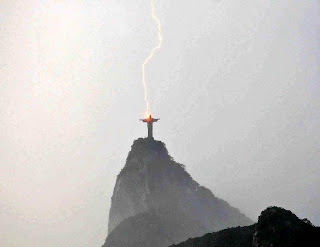
In somewhat unrelated news, lighting struck the world's biggest Jesus yesterday. More on Brazil below...
To that end, I've reveled in a mass of indicators on a gargantuan Excel spreadsheet from various sources for economic, financial, and democratic indicators. I've only scratched the surface, and already some pretty delicious revelations. Firstly, among the commonly-referred to BRICs (Brazil, Russia, India and China), there is no data to support the conventional thesis that democracy breeds GDP growth (neither net GDP nor per capita). I measured democratization according to the Economist Intelligence Unit's Democracy Index.

Economist Intelligence Unit's 2007 Democracy Index Map (lighter blue indicates higher democracy)
In fact, within this group, the non-democratic states (Russia and China) edged out the democratic states (Brazil and India) in growth, both net and per capita. There is no correlation between degree of democratization and level of economic freedom either (as measured by the Heritage Foundations Economic Freedom Index). Nor is there a strong connection between economic freedom and growth, since all four registered in toward the bottom of all nations in terms of economic freedom.
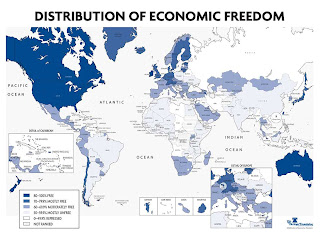
Heritage Foundation's Economic Freedom Index Map (darker blue indicates higher economic freedom)
There does, however, seem to be a correlation between poverty rates (self-reported, and thus somewhat unreliable) and the UN Human Development Index, and democratization. I'm still working on crunching the Gini Coefficient for economic inequality, but I have an inkling I'll find no real correlation between democracy and economic equality. If that turns out to be the case, this will all make for a true bombshell.
I next examined the "Next Eleven" (N-11) economies (Bangladesh, Egypt, Indonesia, Iran, Mexico, Nigeria, Pakistan, the Philippines, South Korea, Turkey, and Vietnam) which were slated in 2005 by Goldman Sachs to be the next nodes of emerging market high-growth.
These nations ranked even lower than the BRICs in terms to democratization. Shockingly, among the N-11s, the more-nuanced correlation between lack of democracy and GDP growth was far more pronounced. The "authoritarian regimes" of Egypt, Iran, Nigeria, Pakistan, and Vietnam together clocked rates 5.05% higher net GDP growth than the "flawed democracies" of Bangladesh, Indonesia, Mexico, the Philippines and South Korea (the "hybrid regime" of Turkey fit in the middle, but didn't skew the rates toward either camp since its indicators were all almost exactly average). However, the democratic states did beat out the un-democratic states in per capita GDP growth (by 3.58 %). Perhaps then we have a wash here. Again, with static analysis of the Gini Coefficient, it will become clear whether this translates into higher degrees of economic equality among the democracies.

World map of Gini Coefficient for 2007/2008 (a lower Gini Coefficient correlates with a lower inequality, with yellow nations having the lowest inequality and fushia nations having the highest). Data source: United Nations Human Development Report 2007-2008.
Fascinatingly, the democratic states among the N-11 did show a strong correlation between democracy and growth in economic freedom, but one counter to conventional thinking. The un-democratic regimes grew an average of 5.5 percent over the last decade in the Economic Freedom Index, compared to the democratic regimes, which declined 3.9 percent in economic freedom. Bangladesh and Indonesia declined the most sharply, falling 7.1 and 9.5 percent respectively. The strongest increase in economic freedom was witnessed in the least democratic state among the N-11, Vietnam, with a 9.4 percent increase (albeit from a low starting point).
Next, I've moved to a master spreadsheet of every economy in the world with reliable data (161 at present). Last night I finished entering the indicators for the Economist Intelligence Unit's Democracy Index, Freedom House's Freedom in the World Survey Combined Freedom Status (for 1996-2006), the Heritage Foundation's Economic Freedom Index (for 1996-2008), and UN Net GDP Growth Rates (for 1996-2006). Remaining is to enter the UN and/or World Bank Per Capita GDP Growth Rates, the Gini Coefficient, the Transparency International World Corruption Index, and the UN Human Development Index. After I crunch all those, looking for linear relationships, I'm going to tease out trends within subcategories--by region, religion, labor force, and energy-exporter vs. non-energy-exporter. I'll publish my findings tomorrow.
On of the hypotheses I hope to test is the "Dutch disease" thesis holding that economies (like Russia, Nigeria, Venezuela, and the Gulf states) reliant upon energy exports for their economic growth will tend to suffer from stunted democratization.

Map of Organization of the Petroleum Exporting Countries (Algeria, Angola, Indonesia, Iran, Iraq, Kuwait, Libya, Nigeria, Qatar, Saudi Arabia, the United Arab Emirates, Venezuela, and Ecuador)
If a more labor-intensive export-led economy like China's spreads the fruits of its growth more widely than a non-labor-intensive export-led economy like Saudi Arabia, then perhaps we'll see a much more rapid journey toward democracy in the Middle Kingdom. Perhaps it will even surpass Russia, reliant as it is today on a rentier economy, and state-led energy export for its economic growth. China shares many characteristics with the Four Asian Tigers of the 1960s and 70s (export-driven growth, high US Treasury Bond holdings, favorable balance of trade, high domestic savings rates, cheap-but-educated labor force, sustained double-digit GDP growth, trade with industrialized nations, etc.). Japan, Taiwan, South Korea, Singapore, Hong Kong, the Philippines, Malaysia, and Indonesia all transitioned toward democracy from authoritarian regimes along a very similar path.
I'm foreseeing a picture wherein the development model works best as it goes through incremental states of political-economy. At first, there is authoritarianism, providing the stability and cohesion necessary to till a infrastructural and macro-economic soil fertile for growth. However, within this authoritarian framework, there is rule of law, economic freedom, and declining corruption. The citizens have legal and economic freedom, but not yet political or civil freedom. As the economic fundamentals are set into place, growth occurs rapidly. The industries responsible for the growth should be labor-intensive and value-added (raw commodity exports won't do the trick), employing the citizenry, giving them "ownership" of the growth, and avoiding the great hoarding of the wealth into government coffers or into the hands of oligarchs (avoiding "Dutch disease"). Entrepreneurship is encouraged, a middle class arises, and the economy becomes increasingly diversified. Thus does a professional citizen class arise: self-sufficient, economically independent, with a stake in the political-economy of the nation. Once this occurs, associative freedom can and does liberalize, allowing these professional stake-holders to inherit the reigns first of civil society and then political society. This is where populism goes astray, allowing too much power in the hands of a mob of people who neither have the stake-holder mentality nor the education and independent means to progress beyond zero-sum identity politics.
This is the path I can foresee for China especially. I think the Beijing government have been responsible stewards, avoiding and attempting to stem the corruption of the provinces (and leaving party leaders who line their pockets hanging from the gallows). They've invested wisely in infrastructure, and allowed metropolitan clusters along the coast to thrive autonomously. They've avoided smothering this growth through either burdensome taxation or statism, but China does not share the same levels of economic freedom that characterized the Four Asian Tigers (and the trend has been static for the past decade, even declining slightly by 0.3% from 1998 levels). Then again, neither do the other BRICs, and the N-11s measure lower than average. A middle class that is projected to be double the population of the United States by 2015 has arisen, and they've been cautious stake-holders in the growth. Beijing has allowed a transition of an enormous number out of poverty in the interior to prosperity on the coast, without allowing the floodgates to open too wide (leading to the urban poverty of so many other Third World slum cities like Lagos). Chinese people have a domestic savings rate of a whopping 50% (large stores of domestic capital liquidity), the government has sizable U.S. Treasury Bond holdings, a very favorable balance of trade (even despite its voracious appetite for energy and raw commodities imports), counts industrialized nations as its largest trading partners, and has reported double-digit growth for the past decade. Once more, its pursued a increasingly popular non-interventionist "just business" strategy in foreign affairs. If the Asian Tiger model is any indication, Chinese Democracy will not just be the title of the upcoming Guns N' Roses album.

Stay tuned...

In somewhat unrelated news, lighting struck the world's biggest Jesus yesterday. More on Brazil below...
To that end, I've reveled in a mass of indicators on a gargantuan Excel spreadsheet from various sources for economic, financial, and democratic indicators. I've only scratched the surface, and already some pretty delicious revelations. Firstly, among the commonly-referred to BRICs (Brazil, Russia, India and China), there is no data to support the conventional thesis that democracy breeds GDP growth (neither net GDP nor per capita). I measured democratization according to the Economist Intelligence Unit's Democracy Index.

Economist Intelligence Unit's 2007 Democracy Index Map (lighter blue indicates higher democracy)
In fact, within this group, the non-democratic states (Russia and China) edged out the democratic states (Brazil and India) in growth, both net and per capita. There is no correlation between degree of democratization and level of economic freedom either (as measured by the Heritage Foundations Economic Freedom Index). Nor is there a strong connection between economic freedom and growth, since all four registered in toward the bottom of all nations in terms of economic freedom.

Heritage Foundation's Economic Freedom Index Map (darker blue indicates higher economic freedom)
There does, however, seem to be a correlation between poverty rates (self-reported, and thus somewhat unreliable) and the UN Human Development Index, and democratization. I'm still working on crunching the Gini Coefficient for economic inequality, but I have an inkling I'll find no real correlation between democracy and economic equality. If that turns out to be the case, this will all make for a true bombshell.
I next examined the "Next Eleven" (N-11) economies (Bangladesh, Egypt, Indonesia, Iran, Mexico, Nigeria, Pakistan, the Philippines, South Korea, Turkey, and Vietnam) which were slated in 2005 by Goldman Sachs to be the next nodes of emerging market high-growth.
These nations ranked even lower than the BRICs in terms to democratization. Shockingly, among the N-11s, the more-nuanced correlation between lack of democracy and GDP growth was far more pronounced. The "authoritarian regimes" of Egypt, Iran, Nigeria, Pakistan, and Vietnam together clocked rates 5.05% higher net GDP growth than the "flawed democracies" of Bangladesh, Indonesia, Mexico, the Philippines and South Korea (the "hybrid regime" of Turkey fit in the middle, but didn't skew the rates toward either camp since its indicators were all almost exactly average). However, the democratic states did beat out the un-democratic states in per capita GDP growth (by 3.58 %). Perhaps then we have a wash here. Again, with static analysis of the Gini Coefficient, it will become clear whether this translates into higher degrees of economic equality among the democracies.

World map of Gini Coefficient for 2007/2008 (a lower Gini Coefficient correlates with a lower inequality, with yellow nations having the lowest inequality and fushia nations having the highest). Data source: United Nations Human Development Report 2007-2008.
Fascinatingly, the democratic states among the N-11 did show a strong correlation between democracy and growth in economic freedom, but one counter to conventional thinking. The un-democratic regimes grew an average of 5.5 percent over the last decade in the Economic Freedom Index, compared to the democratic regimes, which declined 3.9 percent in economic freedom. Bangladesh and Indonesia declined the most sharply, falling 7.1 and 9.5 percent respectively. The strongest increase in economic freedom was witnessed in the least democratic state among the N-11, Vietnam, with a 9.4 percent increase (albeit from a low starting point).
Next, I've moved to a master spreadsheet of every economy in the world with reliable data (161 at present). Last night I finished entering the indicators for the Economist Intelligence Unit's Democracy Index, Freedom House's Freedom in the World Survey Combined Freedom Status (for 1996-2006), the Heritage Foundation's Economic Freedom Index (for 1996-2008), and UN Net GDP Growth Rates (for 1996-2006). Remaining is to enter the UN and/or World Bank Per Capita GDP Growth Rates, the Gini Coefficient, the Transparency International World Corruption Index, and the UN Human Development Index. After I crunch all those, looking for linear relationships, I'm going to tease out trends within subcategories--by region, religion, labor force, and energy-exporter vs. non-energy-exporter. I'll publish my findings tomorrow.
On of the hypotheses I hope to test is the "Dutch disease" thesis holding that economies (like Russia, Nigeria, Venezuela, and the Gulf states) reliant upon energy exports for their economic growth will tend to suffer from stunted democratization.

Map of Organization of the Petroleum Exporting Countries (Algeria, Angola, Indonesia, Iran, Iraq, Kuwait, Libya, Nigeria, Qatar, Saudi Arabia, the United Arab Emirates, Venezuela, and Ecuador)
If a more labor-intensive export-led economy like China's spreads the fruits of its growth more widely than a non-labor-intensive export-led economy like Saudi Arabia, then perhaps we'll see a much more rapid journey toward democracy in the Middle Kingdom. Perhaps it will even surpass Russia, reliant as it is today on a rentier economy, and state-led energy export for its economic growth. China shares many characteristics with the Four Asian Tigers of the 1960s and 70s (export-driven growth, high US Treasury Bond holdings, favorable balance of trade, high domestic savings rates, cheap-but-educated labor force, sustained double-digit GDP growth, trade with industrialized nations, etc.). Japan, Taiwan, South Korea, Singapore, Hong Kong, the Philippines, Malaysia, and Indonesia all transitioned toward democracy from authoritarian regimes along a very similar path.
I'm foreseeing a picture wherein the development model works best as it goes through incremental states of political-economy. At first, there is authoritarianism, providing the stability and cohesion necessary to till a infrastructural and macro-economic soil fertile for growth. However, within this authoritarian framework, there is rule of law, economic freedom, and declining corruption. The citizens have legal and economic freedom, but not yet political or civil freedom. As the economic fundamentals are set into place, growth occurs rapidly. The industries responsible for the growth should be labor-intensive and value-added (raw commodity exports won't do the trick), employing the citizenry, giving them "ownership" of the growth, and avoiding the great hoarding of the wealth into government coffers or into the hands of oligarchs (avoiding "Dutch disease"). Entrepreneurship is encouraged, a middle class arises, and the economy becomes increasingly diversified. Thus does a professional citizen class arise: self-sufficient, economically independent, with a stake in the political-economy of the nation. Once this occurs, associative freedom can and does liberalize, allowing these professional stake-holders to inherit the reigns first of civil society and then political society. This is where populism goes astray, allowing too much power in the hands of a mob of people who neither have the stake-holder mentality nor the education and independent means to progress beyond zero-sum identity politics.
This is the path I can foresee for China especially. I think the Beijing government have been responsible stewards, avoiding and attempting to stem the corruption of the provinces (and leaving party leaders who line their pockets hanging from the gallows). They've invested wisely in infrastructure, and allowed metropolitan clusters along the coast to thrive autonomously. They've avoided smothering this growth through either burdensome taxation or statism, but China does not share the same levels of economic freedom that characterized the Four Asian Tigers (and the trend has been static for the past decade, even declining slightly by 0.3% from 1998 levels). Then again, neither do the other BRICs, and the N-11s measure lower than average. A middle class that is projected to be double the population of the United States by 2015 has arisen, and they've been cautious stake-holders in the growth. Beijing has allowed a transition of an enormous number out of poverty in the interior to prosperity on the coast, without allowing the floodgates to open too wide (leading to the urban poverty of so many other Third World slum cities like Lagos). Chinese people have a domestic savings rate of a whopping 50% (large stores of domestic capital liquidity), the government has sizable U.S. Treasury Bond holdings, a very favorable balance of trade (even despite its voracious appetite for energy and raw commodities imports), counts industrialized nations as its largest trading partners, and has reported double-digit growth for the past decade. Once more, its pursued a increasingly popular non-interventionist "just business" strategy in foreign affairs. If the Asian Tiger model is any indication, Chinese Democracy will not just be the title of the upcoming Guns N' Roses album.
Stay tuned...
Wednesday, February 6, 2008
Fighting the Terrorists with Wikipedia

We kicked off this year with a very successful joint DC-area Society of Competitive Intelligence Professionals (SCIP)-World Future Society (WFS) meeting at the Embassy Suites in Friendship Heights on January 28. And a strange thing happened.... men and women, young and old, of grey flannel suites and scraggly beards, of the World Bank and Booz Allen--all furtively mingling over turkey half-subs and mini bottles of Canada Dry. After brief opening remarks by SCIP President, August Jackson, and our own Eric Garland, WFS President, the crowd was drawn into the web 2.0 gospel of CIA "evangelist" Sean Dennehy. Mr. Dennehy is the chief of development for the Agency's Intellipedia project, using a Wiki platform to share intelligence throughout the Agency.
Yes, ladies and gentlemen, the spooks have their own Wikipedia, and it is wicked cool.

Imagine if you will, an agent at "The Farm" in York County, Virginia, by the name of Austin Powers. He uploads Intellipedia, desperate to find out the latest intelligence on Cuban dictator Fidel Castro's choice of undergarments. Thankfully, secret agent Jack Bauer has just tapped an asset in the upper Amazon jungle, a certain Gap sales associate known only as Kevin. Instantly, agent Bauer uploads the vital secrets he's garnered from asset Kevin via satellite Blackberry to Intellipedia. As Powers scrolls down the "Fidel Castro" article, he finds just what he was looking for: "Castro is known to favor red briefs (he finds them 'revolutionary'), having raided the entire store supply during a super-sweet 50% off sale last Saturday. In other news, Castro totally kicked Hugo Chávez's butt in Wii Tennis yesterday..." Just then, agent Bond intercedes on the edit page from a hotel in downtown Buenos Aires. He's just gotten word that Castro has unexpectedly switched to white skivvies, according to hot info from a Havana laundry worker named Mirta de Jesus. A lively discussion and weighing of evidence occurs in the discussion section. Dozens of agents from all corners of the globe are involved. Later that afternoon, it finally comes to light that Casto was quite tired of Mirta accidentally bleaching all his favored red underpants, turning them an embarrassing shade of pink. Thus, to avoid such faux pas, he has acceded to white briefs. Case closed.

Synergy! Suddenly the entire collective memory of the Agency could be available at the fingertips of any agent anywhere in the world. Instead of having disconnected pieces of information languishing on thousands of different hard drives or allowing actionable intelligence to rot on the vine in the field, there is now the promise of collaborative information woven together on a single, universally accessible platform.
The thing that shocked and intrigued the crowd the most was the fundamental sea-change we had now undergone. The CIA, most secretive of all organs of American governance, most jealous guardian of privileged information, had now embraced a collaborative technology that rewarded sharing rather than hoarding. Furthermore, perhaps uncharacteristically for a government program, the Intellipedia project was not forced on agents from above. It was fed into the system, to be adopted by individuals if and when they found it useful. It's spectacularly successful, reaching high levels of penetration throughout not just the CIA, but the NSA, Army Intelligence, etc. And guess what, the most prolific poster to Intellipedia is 67-years-old.
If the people who depend on information as their major weapon against the enemies of the United States think a Wiki is good enough for them, why not you?
Saturday, January 26, 2008
Greene on Green
For Immediate Release:
"Geoff Greene of Greene Futures announced today that he will be transitioning toward a carbon-neutral blogging model, by hooking his MacBook Pro to a Voltaic Systems solar-panel backpack for clean energy, and buying carbon offsets to reduce the ecological impact of his Blogger server space..."
Well, not really.
But it sounds quite familiar, eh? Yes, everyone from British Petroleum ("What size is your footprint?") to the Miami Beach Marina Sailfish Tournament ("The world's first carbon-neutral fishing tournament") are jumping on the green-wagon. Great news, right?

"Man, Billy-Bob, ice fishing just ain't the same, what with global warming 'n' all..."
Ladies and gentlemen, if I hear another beaming reference to eco/green/clean/organic shoes, toothbrushes or lawn gnomes, I may become green with nausea. And not because my name is Senator James M. Inhofe of Oklahoma and consider global climate change the "greatest hoax ever perpetrated on the American people."
No, it boils down to the fact that a pig with lipstick on is still a pig. And just the same, slapping the label "green" on any good or service you durn-well please merely causes apathy and cynicism among consumers.

"'Well BP, I'm gonna need a few more drinks to become
convinced that you really care about the environment"
The environmental marketing company TerraChoice came out with a study last month called the The Six Sins of Greenwashing, which asserts that a full 99% of 1,018 common consumer products are guilty of "greenwashing." That is, these products are far more style than substance, marketing to the consumer the image of environmental consciousness and health without any substantial evidentiary basis. Enviromedia Social Marketing's Greenwashing Index catalogs such "sinners" by having users post and rate ads according to the Index, very similar to TerraChoices's Six Sins metric. Thusly, does a web 2.0 tool apply consumer pressure via social networking in an attempt to keep companies honest.
This is not merely an image issue, either. TerraChoice, in its study, judged the products in question according to existing Federal Trade Commission false advertising regulations guidlines, as well as parallel regulations in all 50 states. In the early 1990s, the combination of muckraking journalists and a regulatory crackdown deflated the last incarnation of this green business trend. At that time, the FTC cracked down on several purveyors and in 1990 A task force of state attorneys general, headed by Minnesota's, Hubert H. Humphrey III, held hearings and issued two reports with new guidelines. The result was a cooling effect on both the producers and on consumer perception of green business that lingers to this day. Might the same occur once again?
Consumers (such as myself) are overtired of hearing green claims shoved down their throats from all angles. Canadian market research company Ipsos Reid published a report last October finding that 70% of Americans and 65% of Canadians say green labeling is "just a marketing tactic."
EcoAlign's 2007 EcoPinion Survey found among the 54% of consumers who haven’t already adopted green technology, they perceive it to be “ugly,” “expensive,” and “difficult to understand and maintain.” In other words, potential converts are quite skeptical, and have generally negative feelings towards green products and services.
According to IBM Global Business Services' Plugging in the Consumer: Innovating utility business models for the future (2007), only 15% of Americans have quantified their “carbon footprint,” despite widespread attention given to the fad.
Even green energy, the most talked-about and well-financed wing of the green business movement, still leaves consumers scratching their heads. According to the same 2007 EcoPinion Survey, 30% of consumers don’t know what “clean energy” is at all. Only 13% of the studied think energy efficiency has to do with saving money or cutting down on fuel costs.
What does this all mean for you?
"Geoff Greene of Greene Futures announced today that he will be transitioning toward a carbon-neutral blogging model, by hooking his MacBook Pro to a Voltaic Systems solar-panel backpack for clean energy, and buying carbon offsets to reduce the ecological impact of his Blogger server space..."
Well, not really.
But it sounds quite familiar, eh? Yes, everyone from British Petroleum ("What size is your footprint?") to the Miami Beach Marina Sailfish Tournament ("The world's first carbon-neutral fishing tournament") are jumping on the green-wagon. Great news, right?

"Man, Billy-Bob, ice fishing just ain't the same, what with global warming 'n' all..."
Ladies and gentlemen, if I hear another beaming reference to eco/green/clean/organic shoes, toothbrushes or lawn gnomes, I may become green with nausea. And not because my name is Senator James M. Inhofe of Oklahoma and consider global climate change the "greatest hoax ever perpetrated on the American people."
No, it boils down to the fact that a pig with lipstick on is still a pig. And just the same, slapping the label "green" on any good or service you durn-well please merely causes apathy and cynicism among consumers.

"'Well BP, I'm gonna need a few more drinks to become
convinced that you really care about the environment"
The environmental marketing company TerraChoice came out with a study last month called the The Six Sins of Greenwashing, which asserts that a full 99% of 1,018 common consumer products are guilty of "greenwashing." That is, these products are far more style than substance, marketing to the consumer the image of environmental consciousness and health without any substantial evidentiary basis. Enviromedia Social Marketing's Greenwashing Index catalogs such "sinners" by having users post and rate ads according to the Index, very similar to TerraChoices's Six Sins metric. Thusly, does a web 2.0 tool apply consumer pressure via social networking in an attempt to keep companies honest.
This is not merely an image issue, either. TerraChoice, in its study, judged the products in question according to existing Federal Trade Commission false advertising regulations guidlines, as well as parallel regulations in all 50 states. In the early 1990s, the combination of muckraking journalists and a regulatory crackdown deflated the last incarnation of this green business trend. At that time, the FTC cracked down on several purveyors and in 1990 A task force of state attorneys general, headed by Minnesota's, Hubert H. Humphrey III, held hearings and issued two reports with new guidelines. The result was a cooling effect on both the producers and on consumer perception of green business that lingers to this day. Might the same occur once again?
Consumers (such as myself) are overtired of hearing green claims shoved down their throats from all angles. Canadian market research company Ipsos Reid published a report last October finding that 70% of Americans and 65% of Canadians say green labeling is "just a marketing tactic."
EcoAlign's 2007 EcoPinion Survey found among the 54% of consumers who haven’t already adopted green technology, they perceive it to be “ugly,” “expensive,” and “difficult to understand and maintain.” In other words, potential converts are quite skeptical, and have generally negative feelings towards green products and services.
According to IBM Global Business Services' Plugging in the Consumer: Innovating utility business models for the future (2007), only 15% of Americans have quantified their “carbon footprint,” despite widespread attention given to the fad.
Even green energy, the most talked-about and well-financed wing of the green business movement, still leaves consumers scratching their heads. According to the same 2007 EcoPinion Survey, 30% of consumers don’t know what “clean energy” is at all. Only 13% of the studied think energy efficiency has to do with saving money or cutting down on fuel costs.
What does this all mean for you?
- Transition to green business for pure marketing value is a waste of time and money. Consumers are confused and skeptical. Worse still, you may likely incur the regulatory wrath of Uncle Sam (or "the Governator").
- If you do do it, it should be for cold hard dollars and cents. You can witness dramatic savings in production, operation and distribution costs through increases in efficiency and decreases in waste. Ernst & Young speculates that rising energy costs and efficiency will drive the green business trend. When energy costs rise--and $100/barrel oil is only the beginning--so do the competitive advantages of efficiency. Furthermore, you can reap opportunity for growth if you are the first to a developing market. Guess who the richest man in China is right now? None other that Shi Zhengrong of Suntech Power, who made his billions by selling cheap solar panels worldwide.
- Don't even include your marketing department. Leave this one to the bean counters and the engineers. The "boy who cried wolf effect" assures that even the most sincere and substantial efforts will be viewed with skepticism if you market them to forcibly. The type of consumers whom you can impress through your efforts are information-savvy, and will discover what you've done themselves. Be nuanced, and allow your actions (not words) to matriculate through the infosphere via word-of-mouth and third-party reports (newspapers, magazines, television shows and blogs).
Friday, January 25, 2008
Hoya Philosopher-Kings: Epologue

In retrospect, getting dragged into an email flame war with right-wing talk-radio host John Ziegler was not only juvenile, but completely irrelevant to the purpose of Greene Futures. Many apologies to my wonderful readers especially, but also to Mr. Ziegler. He is what he is, and is entitled to his opinions, no matter how bigoted I consider them. And Greene Futures is certainly not the place to seek for monsters to destroy.
Thusly, in the future, Greene Futures will be resolutely dedicated to the future. Leave the politicking to the present.
Best regards,
Geoff Greene
Wednesday, January 23, 2008
Hoya Philosopher-Kings
Today's entry is addressed primarily to my alumni peers, but will be of interest to anyone interested in what leaders and ideas emerge from the Georgetown School of Foreign Service, former stomping ground of President William Jefferson Clinton, and many other Future Leaders of the Free World:
The Atlantic Monthly, which in my humble opinion is one of the two top magazines in the United States (standing shoulder-to-shoulder with The New Yorker), just opened its website to non-subscribers, as well as its archives back to its genesis as an abolitionist paper in the mid-19th Century. Here is a very interesting 2005 article about fellow Hoya and (former) radio host John Ziegler, which gives an enlightening glimpse into the world of right-wing talk radio:
http://www.theatlantic.com/doc/200504/wallace

That being a medium that the more liberal populace is only vaguely aware, and totally unacquainted with directly. However, in its aggregate, this crackling chorus of immigrant-bashing, "Islamo-fascism" rabble-rousing, Bible-thumping, shout-you-out-of-the-room "straight talk" is the bass-line of propaganda which delivers a pre-chewed spoonful of opinions to half of the electorate every morning. The faithfully regurgitated refrain "Rush [Limbaugh] is right" is code for the unquestioning fervor with which devotees of these modern-day Joseph Goebbels demure to he loudest voice they can find on the AM spectrum. Concerning Mr. Ziegler, it is interesting to consider how a "recovering Catholic" who studied government and philosophy on the Hilltop would court an opinion of "the Arab world" as follows:
"We're not perfect, we suck a lot of the time, but we are better as a people, as a culture, and as a society than they are, and we need to recognize that, so that we can possibly even begin to deal with the evil that we are facing."
Now, Mr. Ziegler graduated in 1989. I wonder how many Georgetown graduates have carried such zealous ideas into the seats of power from that era, and how many might exit Healy Gates thinking the same today? Does a Catholic institution, which is based upon the continuing Vatican ideology of the "One True Church," encourage such feelings of cultural supremacy? Has this the oldest university in Washington, DC, which traces its genesis to the birth of the Constitution in 1789, inherited and fostered the old Puritan conception of the "New American Israel" carrying out God's Divine Plan in the world?

Cotton Mather (1663-1728), influential American Puritan, Salem Witch Trial rabble-rouser, and author of Theopolis Americana: An Essay on the Golden Street of the Holy City and The Negro Christianized: An Essay to Excite and Assist that Good Work, the Instruction of Negro-Servants in Christianity (PDF).
The pedagogy of the government department--if it includes references to "the Arab world" at all--tends to do so through the prism of terrorism or the Israeli-Palestinian conflict (i.e. lumping the region with Africa as a land of unremitting and irrational ancient violence). Philosophy courses too include mainly Plato, St. Augustine, Aquinas, Kant, Hegel, Nietzsche, Heidegger, etc. but only peripheral coverage of "Eastern philosophy" (and only then with a quick and dirty gloss). Don't believe me, check the Spring 2008 course listing for yourself. Browse too the government department offerings, and notice the consistent theme of "security" among almost all courses concerning Asia, Africa or the Middle East. In fairness, the School of Foreign Service (which does not house Mr. Ziegler's government or philosophy majors) offers several more nuanced courses--to those who seek them.

This is what all Arabs look like, even when showering.
Would the average undergraduate take a course on the great Islamic philosophers, or appreciate the pan-Mediterranean development of what we now consider to be "Western" thought? Where would men like John Ziegler learn that while the post-Roman European continent effectively lost literacy for a full millennium, the Islamic and Jewish scholars of the umma preserved the works of Aristotle and his ancient Greek contemporaries? Where would they learn that until the 18th Century, China far outshone Europe in wealth, power and influence? Where might they connect the half-century of violence in the Middle East with the exploitative and ideologically-blinded 20th Century foreign policies of Great Britain, France, Russia, Israel and the United States?
Where might you take a course that teaches that the world outside the United States and Europe is filled with real-live human beings who work, get married, have children, fear war, pine for peace, eat McDonalds, faithfully tune in to Oprah, and are likely be crying to Atonement ("the most achingly romantic movie since Titanic!") on bootleg DVD as we speak.
For every "Arabist" who steps across the Georgetown stage to inherit the world, there are two security studies graduates who view the "Islamo-Confucian" world (an actual Samuel Huntington neologism from his 1993 article-cum-book The Clash of Civilizations) as a dreamworld of wealth and war. Enticing for her Eastern riches, but alien and somehow unrecognizable. And so these people are more than happy to spread a condescending hand to the "more-rational" few that can be found among the Oriental mass, sending money, advice, and arms to our men in the Jordans, Egypts, Moroccos, Saudis, Bahrains, Pakistans, Japans, South Koreas and Taiwans of the world. Even these--our "friends"--are merely children in our foreign policy family. They are given a yearly allowance of foreign direct aid, and expected to jump when told. As Mr. Ziegler stated (with refreshing candor, at least), "we are better as a people, as a culture, and as a society," and only we can deserve the responsibility of democracy. Thus, it is no coincidence that our primary allies in the Arab world are monarchies and dictatorships, and our nominal enemies are in the more democratic elements in the area (Iran, Yemen, Lebanon and Palestine). In the global Platonic Republic, the United States comprises the philosopher-kings and warriors of the guardian class, along with the elites of our client states acting as middle-management. The oil fields and trinket factories of the East are populated by the inferior producer class who's role it is to create wealth to support the guardian class, but who lack the ability and education to direct their own destiny.
I don't perceive that a standard Georgetown education would do anything to contradict this worldview. If anything, I've believed that Georgetown's self-aware role is to educate the American philosopher-kings, as well as their viceroy elites abroad. My Jordanian friend offered me the (apocryphal) anecdote yesterday that half his country's Parliament was educated at Georgetown. Crown Prince Abdullah II, for one, achieved a School of Foreign Service master's degree in 1987. Our many international students, past and present, comprise a laundry list of elite children from all corners of the globe--they who have the capacity to shell out $45,000 cash per year.
It is not my intent to monger conspiracies, rail against the "Illumniati cabal" directing the world or to indulge in anti-American self-loathing. I will argue fiercely to anyone that among the practical options, the United States is the least-bad guardian of the world. Nor do I blame Georgetown solely for the propagation of unfortunate beliefs among its students. I sought out and found there a wellspring of elucidating knowledge and empathy for the global human condition. But for many, if not most, of my peers, the promise of such enlightenment was lost. For them, the highest opportunity lies in an investment bank.
I don't buy that "we are better as a people." Furthermore, it seems to me that such thought is self-defeating and contrary to the interest of American leadership. I've bemoaned the foolish pride and bravado superiority that has led us into fiascoes like Iraq, that leads us to support Israel in starving the Gazans in the midst of a Middle East peace process. I've lamented how those who would sort the world into a hierarchy of humanity have both undervalued the worth of innocent lives and underestimated the potential of our competitors and enemies. It is not only long-suffering civilians in Baghdad and Gaza whom we hurt, but also our ambitions and our selves.
That great Catholic thinker Thomas Aquinas once said "inordinate self-love is the cause of every sin," and certainly our recent experience would seem to bear that out. Can we learn to practice humility as well as forthrightness? Can we lead by example rather than by force? Or will we become the next Soviet Union, treating the world as a canvas for our ideology rather than a vast land ripe with hope? These values will determine the future of American leadership, and academies like Georgetown determine what values these leaders will embody. Leaders who truly embody the Jesuit promise hold true to both the Ignatian ideals of "men for others" and "men with others." It is the latter that differentiates the loved from the feared.
The Atlantic Monthly, which in my humble opinion is one of the two top magazines in the United States (standing shoulder-to-shoulder with The New Yorker), just opened its website to non-subscribers, as well as its archives back to its genesis as an abolitionist paper in the mid-19th Century. Here is a very interesting 2005 article about fellow Hoya and (former) radio host John Ziegler, which gives an enlightening glimpse into the world of right-wing talk radio:
http://www.theatlantic.com/doc

That being a medium that the more liberal populace is only vaguely aware, and totally unacquainted with directly. However, in its aggregate, this crackling chorus of immigrant-bashing, "Islamo-fascism" rabble-rousing, Bible-thumping, shout-you-out-of-the-room "straight talk" is the bass-line of propaganda which delivers a pre-chewed spoonful of opinions to half of the electorate every morning. The faithfully regurgitated refrain "Rush [Limbaugh] is right" is code for the unquestioning fervor with which devotees of these modern-day Joseph Goebbels demure to he loudest voice they can find on the AM spectrum. Concerning Mr. Ziegler, it is interesting to consider how a "recovering Catholic" who studied government and philosophy on the Hilltop would court an opinion of "the Arab world" as follows:
"We're not perfect, we suck a lot of the time, but we are better as a people, as a culture, and as a society than they are, and we need to recognize that, so that we can possibly even begin to deal with the evil that we are facing."
Now, Mr. Ziegler graduated in 1989. I wonder how many Georgetown graduates have carried such zealous ideas into the seats of power from that era, and how many might exit Healy Gates thinking the same today? Does a Catholic institution, which is based upon the continuing Vatican ideology of the "One True Church," encourage such feelings of cultural supremacy? Has this the oldest university in Washington, DC, which traces its genesis to the birth of the Constitution in 1789, inherited and fostered the old Puritan conception of the "New American Israel" carrying out God's Divine Plan in the world?

Cotton Mather (1663-1728), influential American Puritan, Salem Witch Trial rabble-rouser, and author of Theopolis Americana: An Essay on the Golden Street of the Holy City and The Negro Christianized: An Essay to Excite and Assist that Good Work, the Instruction of Negro-Servants in Christianity (PDF).
The pedagogy of the government department--if it includes references to "the Arab world" at all--tends to do so through the prism of terrorism or the Israeli-Palestinian conflict (i.e. lumping the region with Africa as a land of unremitting and irrational ancient violence). Philosophy courses too include mainly Plato, St. Augustine, Aquinas, Kant, Hegel, Nietzsche, Heidegger, etc. but only peripheral coverage of "Eastern philosophy" (and only then with a quick and dirty gloss). Don't believe me, check the Spring 2008 course listing for yourself. Browse too the government department offerings, and notice the consistent theme of "security" among almost all courses concerning Asia, Africa or the Middle East. In fairness, the School of Foreign Service (which does not house Mr. Ziegler's government or philosophy majors) offers several more nuanced courses--to those who seek them.

This is what all Arabs look like, even when showering.
Would the average undergraduate take a course on the great Islamic philosophers, or appreciate the pan-Mediterranean development of what we now consider to be "Western" thought? Where would men like John Ziegler learn that while the post-Roman European continent effectively lost literacy for a full millennium, the Islamic and Jewish scholars of the umma preserved the works of Aristotle and his ancient Greek contemporaries? Where would they learn that until the 18th Century, China far outshone Europe in wealth, power and influence? Where might they connect the half-century of violence in the Middle East with the exploitative and ideologically-blinded 20th Century foreign policies of Great Britain, France, Russia, Israel and the United States?
Where might you take a course that teaches that the world outside the United States and Europe is filled with real-live human beings who work, get married, have children, fear war, pine for peace, eat McDonalds, faithfully tune in to Oprah, and are likely be crying to Atonement ("the most achingly romantic movie since Titanic!") on bootleg DVD as we speak.
For every "Arabist" who steps across the Georgetown stage to inherit the world, there are two security studies graduates who view the "Islamo-Confucian" world (an actual Samuel Huntington neologism from his 1993 article-cum-book The Clash of Civilizations) as a dreamworld of wealth and war. Enticing for her Eastern riches, but alien and somehow unrecognizable. And so these people are more than happy to spread a condescending hand to the "more-rational" few that can be found among the Oriental mass, sending money, advice, and arms to our men in the Jordans, Egypts, Moroccos, Saudis, Bahrains, Pakistans, Japans, South Koreas and Taiwans of the world. Even these--our "friends"--are merely children in our foreign policy family. They are given a yearly allowance of foreign direct aid, and expected to jump when told. As Mr. Ziegler stated (with refreshing candor, at least), "we are better as a people, as a culture, and as a society," and only we can deserve the responsibility of democracy. Thus, it is no coincidence that our primary allies in the Arab world are monarchies and dictatorships, and our nominal enemies are in the more democratic elements in the area (Iran, Yemen, Lebanon and Palestine). In the global Platonic Republic, the United States comprises the philosopher-kings and warriors of the guardian class, along with the elites of our client states acting as middle-management. The oil fields and trinket factories of the East are populated by the inferior producer class who's role it is to create wealth to support the guardian class, but who lack the ability and education to direct their own destiny.
I don't perceive that a standard Georgetown education would do anything to contradict this worldview. If anything, I've believed that Georgetown's self-aware role is to educate the American philosopher-kings, as well as their viceroy elites abroad. My Jordanian friend offered me the (apocryphal) anecdote yesterday that half his country's Parliament was educated at Georgetown. Crown Prince Abdullah II, for one, achieved a School of Foreign Service master's degree in 1987. Our many international students, past and present, comprise a laundry list of elite children from all corners of the globe--they who have the capacity to shell out $45,000 cash per year.
It is not my intent to monger conspiracies, rail against the "Illumniati cabal" directing the world or to indulge in anti-American self-loathing. I will argue fiercely to anyone that among the practical options, the United States is the least-bad guardian of the world. Nor do I blame Georgetown solely for the propagation of unfortunate beliefs among its students. I sought out and found there a wellspring of elucidating knowledge and empathy for the global human condition. But for many, if not most, of my peers, the promise of such enlightenment was lost. For them, the highest opportunity lies in an investment bank.
I don't buy that "we are better as a people." Furthermore, it seems to me that such thought is self-defeating and contrary to the interest of American leadership. I've bemoaned the foolish pride and bravado superiority that has led us into fiascoes like Iraq, that leads us to support Israel in starving the Gazans in the midst of a Middle East peace process. I've lamented how those who would sort the world into a hierarchy of humanity have both undervalued the worth of innocent lives and underestimated the potential of our competitors and enemies. It is not only long-suffering civilians in Baghdad and Gaza whom we hurt, but also our ambitions and our selves.
That great Catholic thinker Thomas Aquinas once said "inordinate self-love is the cause of every sin," and certainly our recent experience would seem to bear that out. Can we learn to practice humility as well as forthrightness? Can we lead by example rather than by force? Or will we become the next Soviet Union, treating the world as a canvas for our ideology rather than a vast land ripe with hope? These values will determine the future of American leadership, and academies like Georgetown determine what values these leaders will embody. Leaders who truly embody the Jesuit promise hold true to both the Ignatian ideals of "men for others" and "men with others." It is the latter that differentiates the loved from the feared.
Friday, January 11, 2008
America: The Future is Bleak
I am not bullish on the macroeconomic future of the United States. Let us cast aside issues of which party will win the presidency next November (though I will go on record to state that it will certainly by the Democrats). Let us pay no mind to the "political issues" of our age: healthcare, taxes, Iraq, terrorism, etc. No, travel along with me for a moment down to the sub-dermal layer of our society's future... Down to the fundamentals. The meat and potatoes of our destiny.
1) America is a free-market capitalist society, with some socialist elements (the Postal Service, utilities, roads, welfare, Social Security, Medicare, etc.).
2) The logic of capitalism is one of infinite growth. All present investments of capital are made with the expectation that the future will witness a larger market to consume the products of the capital inputs. Otherwise, there can be no profit off these capital investments, and rational investors will not apply resources toward them.
3) Ergo, unless the United States' economy is growing, capital will dry up, leaving businesses and consumers with fewer and more restrictive choices for borrowing. Without such ability to take on debt under reasonable conditions, entrepreneurial opportunities will be left to wither on the vine, potential homeowners will not have access to mortgages and homes, and even established businesses will have difficulty mustering the capital to invest in innovation, growth and expansion. Only those economic actors which have sizable amounts of cash saved will be able to finance such expenditures. Considering the savings rate for Americans now hovers consistently at 2% (down from 10-12% a generation ago), this cashflow is impossible for the average consumer. With few exceptions, businesses, especially small businesses, lack the luxury of slapping cash on the barrel for capital outlays. Thus, without cheap and easy capital to fuel it, the economy could "run out of gas."
4) Which brings us to our next point. The American economy is an energy-hungry one. This is evident to anyone who drives to work in the morning. Americans have few attractive alternatives for transportation to the internal combustion-powered car. Only two cities, New York and Washington, DC, offer public transportation systems for commuters attractive enough to display wide usage. Domestic shipment is reliant upon trucking, domestic and international travel rely upon air travel, and the vast majority of electricity generation in the nation emerges from coal, natural gas, gasoline, and oil-fired plants.
5) Every industrial economy relies upon energy inputs for economic output. The relationship between the units of energy required for every unit of GDP is referred to as energy intensity. The United States has a higher energy intensity (more energy required for each unit of GDP) than Japan, most of the nations of Europe, China and India. With only 3% of the world's people, the US is responsible for a quarter of world resource consumption. This is partly due to the geographic difference between the smaller, more densely populated economies of Japan and the European nations, and the larger, more disparate demographic of the United States (making transportation costs more of a factor). More than 80% of the economic output of the United States is produced in urban zones, and this is consistent among other well-developed nations. This due to the "clustering effect" of reduced transportation costs from density, university research-innovation pipelines, more educated pools of talent, cross-over between firms and industries, etc. However, this geographic difference cannot account for all the disparity, because the Netherlands actually suffer a higher energy intensity than the United States, and India and China are large nations as well (albeit with much more dense populations). The important point here is that the United States requires relatively more energy for every incremental increase in economic output than most other well-developed nations. Furthermore, because Americans have few attractive alternatives to cars for transportation, gasoline is a very inelastic good. In other words, gasoline, like food, is an essential good to Americans, and prices do not affect consumption patterns very much. This is born out by the fact that Americans have not significantly reduced their driving habits, despite spiraling oil prices. Energy costs, from the pump to the thermostat, merely eat up more of the American consumer's income.
6) For this reason, the United States is much more susceptible economically to rising energy costs than its global competitor nations. This is exacerbated by the continued weakness of the US Dollar. Consumers shopping for oil at the world price will have more buying power with the British Pound, Euro, or even Canadian Loonie, relative to the US Dollar.
7) This in the midst of the American housing crisis, which is already putting tremendous strain on the American financial system. More and more signs are emerging of an imminent recession in 2008, with the weak employment numbers this week only being the most recent. If world oil prices continue to increase to and above $100/barrel, the flagging American economy is kicked as it is down.
8) Though I've instructed us to lay aside the political issue of Iraq for a moment here, it will play into this scenario in important ways. Aside from the obvious human costs and geopolitical turmoil resulting from the conflict, estimates for its economic cost have ranged from $1-1.5 trillion. The tremendous outlay by the federal government for a war that is costing $1 billion a day is not being financed by taxpayer monies. It is instead being thrown on top the already tremendous federal debt. This debt is contributing to the weak dollar, increasing economic risk, and a strained regime that requires continued confidence among foreign central banks to continue buying up more debt through US treasury bonds. Furthermore, this debt has merely borrowed against the future, with the requirement that it be paid back eventually. The electorate faces talk of a looming Social Security crisis with mass Baby Boomer retirement, plans for universal healthcare, chronic homeland security costs, an inflating defense department budget, and bleeding sores in Iraq and Afghanistan. Unless the economy grows appreciably in future years--and tax revenues increase substantially from present levels--the government will be hard-pressed to pay its debts while addressing the expensive concerns of Baby Boomer retirement, healthcare woes and the War on Terror.
9) If the primary owners of America's national debt in Japan, China, Britain, and the oil-exporting nations decide that the United States is a credit risk, they will cease to finance more government debt. Furthermore, the flagging dollar may likely convince more and more nations to reduce their dollar reserves in favor of the Euro, or a basket of currencies. Without enjoying the unique status of the world reserve currency, the dollar will continue to grow weaker. Thus, imports, and energy imports, most importantly, would grow increasingly expensive for Americans.
10) Beyond all the slogans for reducing our reliance on oil imports, increasing energy independence, and moving past the fossil fuel economy, any significant changes will be costly and take several decades. Infrastructural projects to give consumers and businesses transportation options beyond automobiles will take political will, many years, and many more billions. Furthermore, technologies to make solar or wind energy cost competitive with fossil fuels for energy are years off. The "hydrogen economy," if it ever materializes, will take decades to develop proper distribution infrastructure, cost-competitive vehicle offerings, and a cost-effective method of sustainable hydrogen generation. Right now, the vast majority of hydrogen is derived by burning fossil fuels. Similarly, ethanol and biodiesel production right now consumes far more energy than it produces. Since modern agriculture requires chemical fertilizers derived from oil, ethanol producers are literally "growing oil with oil." Since electricity is mostly generated from coal, oil, and gas-fired plants, this offers no way out of the fossil fuel trap. Nuclear plants take over a decade to build, face severe "not in my back yard" opposition, present safety and security concerns, and their electricity is far from "too cheap to meter." The price of natural gas has been increasing right along with world oil prices, and will likely soon be organized into a global market (meaning increasing world demand will bear even more heavily on price domestically). There now exists no viable alternative to gasoline that can match its cost-effectiveness, energy density, and portability.
11) China, home to a quarter of the world's people, has grown 9% per year for the past decade, and shows no signs of slowing. It's average household savings rate is a massive 30%, it is a global creditor rather than a debtor nation, and it shoulders no costly wars or overseas military commitments. The United States spends 48% of all world military spending, almost as much as every other nation combined. China only shoulders a seventh this cost for its military. With endless growth, no debt burden, small military expenditures, and easy sources of domestic capital, China is on increasingly good footing relative to the United States.
Implications: What Does All This Mean?
1) America is a big and self-sufficient enough economy that increased import prices from a weak dollar do not matter much per se. However, increased oil import prices do matter--a lot. As oil gets more expensive from increased world demand, peaking supply, refinery undercapacity, and the weak buying power of the US Dollar, the economy will suffer.
2) Until we are able to transition to a more sustainability energy regime beyond fossil fuels (a generation or more hence), the fossil fuel crunch will hurt the United States, and hurt it more than most other industrialized nations.
3) Transportation costs for both businesses and consumers will be a major and increasing percentage of spending. Finding ways to reduce transportation costs will be decisive. Expect the suburban sprawl of the past half century to begin to reverse, as businesses and consumers realize the benefits of density for energy cost reductions. Workers will choose to live closer to their places of work, and to telecommute more often. Political pressure for light rail options will increase. Also, expect the benefits of the aforementioned clustering to increase, drawing more firms toward metropolitan areas, despite the higher real estate costs.
4) The 20th Century shift from rail to trucking in domestic shipment will also begin to reverse, with the energy efficiency of rail preferred over diesel-thirsty trucking. As demand for rail shipment increases, more investment from the public and private sectors will be forthcoming, increasing the versatility and convenience of rail, and decreasing its cost further. This positive feedback loop will ensure the primacy of rail in domestic shipping.
5) Container shipping will be more and more preferred for international applications, over air shipping, which will only grow more costly. A high premium on fast international shipping will call into question the feasibility of the Just in Time (JIT) inventory strategy pioneered by Toyota and in wide use in global business today. Warehousing costs, though significant, will be more and more preferable to even more significant air shipment costs. Improved inventory models may reduce this problem, but in general the paradigm of expensive real estate and relatively cheap transportation will begin to tilt back in favor of real estate.
6) Economies that can increase their energy intensity will win in the world economy. As energy costs increase, those who can eek out more GDP growth on less energy input will enjoy competitive advantage. For now, this confers much advantage to European and Japanese firms relative to American ones. There are many more variables at play, so this is not to suggest that America will be left behind. However, it will occupy a less competitive position relatively than it has.
7) The United States will face an inevitable and painful day of fiscal reckoning within the next decade. With birthrates declining, the workforce aging, and a glut of Baby Boomers entering their winter years, Social Security outlays will be gigantic. Furthermore, there will be fewer and fewer productive workers feeding into the system for every non-productive retired person drawing from the pot. This problem is far more pronounced in Japan, Singapore, and Europe, where birthrates have now dropped to as low as half the replacement rate (the births per woman required to maintain the population steady). In the US, this fiscal crisis will be compounded by the problem of healthcare (which will be very expensive whether the system is universal or not), the massive federal deficit and debt, and a slowing economy. Furthermore, if the dollar is foresaken as the world reserve currency, and central bankers and investors loose confidence in America's economic future, capital will dry up in a negative feedback loop. With potential sources of capital not forthcoming (from either non-saving American citizens or risk-averse central banks and foreign investors), and with a recessionary economy and large fiscal commitments, the federal government will either have to raise taxes (inflaming the economic distress) or cut back on services to close up the deficit and begin paying back the principal and interest on the national debt.
8) All-in-all, you might want to either demand to your boss that you get paid in Euros, move to Canada, or invest a sizeable portion of your pension or 401K in global markets.
1) America is a free-market capitalist society, with some socialist elements (the Postal Service, utilities, roads, welfare, Social Security, Medicare, etc.).
2) The logic of capitalism is one of infinite growth. All present investments of capital are made with the expectation that the future will witness a larger market to consume the products of the capital inputs. Otherwise, there can be no profit off these capital investments, and rational investors will not apply resources toward them.
3) Ergo, unless the United States' economy is growing, capital will dry up, leaving businesses and consumers with fewer and more restrictive choices for borrowing. Without such ability to take on debt under reasonable conditions, entrepreneurial opportunities will be left to wither on the vine, potential homeowners will not have access to mortgages and homes, and even established businesses will have difficulty mustering the capital to invest in innovation, growth and expansion. Only those economic actors which have sizable amounts of cash saved will be able to finance such expenditures. Considering the savings rate for Americans now hovers consistently at 2% (down from 10-12% a generation ago), this cashflow is impossible for the average consumer. With few exceptions, businesses, especially small businesses, lack the luxury of slapping cash on the barrel for capital outlays. Thus, without cheap and easy capital to fuel it, the economy could "run out of gas."
4) Which brings us to our next point. The American economy is an energy-hungry one. This is evident to anyone who drives to work in the morning. Americans have few attractive alternatives for transportation to the internal combustion-powered car. Only two cities, New York and Washington, DC, offer public transportation systems for commuters attractive enough to display wide usage. Domestic shipment is reliant upon trucking, domestic and international travel rely upon air travel, and the vast majority of electricity generation in the nation emerges from coal, natural gas, gasoline, and oil-fired plants.
5) Every industrial economy relies upon energy inputs for economic output. The relationship between the units of energy required for every unit of GDP is referred to as energy intensity. The United States has a higher energy intensity (more energy required for each unit of GDP) than Japan, most of the nations of Europe, China and India. With only 3% of the world's people, the US is responsible for a quarter of world resource consumption. This is partly due to the geographic difference between the smaller, more densely populated economies of Japan and the European nations, and the larger, more disparate demographic of the United States (making transportation costs more of a factor). More than 80% of the economic output of the United States is produced in urban zones, and this is consistent among other well-developed nations. This due to the "clustering effect" of reduced transportation costs from density, university research-innovation pipelines, more educated pools of talent, cross-over between firms and industries, etc. However, this geographic difference cannot account for all the disparity, because the Netherlands actually suffer a higher energy intensity than the United States, and India and China are large nations as well (albeit with much more dense populations). The important point here is that the United States requires relatively more energy for every incremental increase in economic output than most other well-developed nations. Furthermore, because Americans have few attractive alternatives to cars for transportation, gasoline is a very inelastic good. In other words, gasoline, like food, is an essential good to Americans, and prices do not affect consumption patterns very much. This is born out by the fact that Americans have not significantly reduced their driving habits, despite spiraling oil prices. Energy costs, from the pump to the thermostat, merely eat up more of the American consumer's income.
6) For this reason, the United States is much more susceptible economically to rising energy costs than its global competitor nations. This is exacerbated by the continued weakness of the US Dollar. Consumers shopping for oil at the world price will have more buying power with the British Pound, Euro, or even Canadian Loonie, relative to the US Dollar.
7) This in the midst of the American housing crisis, which is already putting tremendous strain on the American financial system. More and more signs are emerging of an imminent recession in 2008, with the weak employment numbers this week only being the most recent. If world oil prices continue to increase to and above $100/barrel, the flagging American economy is kicked as it is down.
8) Though I've instructed us to lay aside the political issue of Iraq for a moment here, it will play into this scenario in important ways. Aside from the obvious human costs and geopolitical turmoil resulting from the conflict, estimates for its economic cost have ranged from $1-1.5 trillion. The tremendous outlay by the federal government for a war that is costing $1 billion a day is not being financed by taxpayer monies. It is instead being thrown on top the already tremendous federal debt. This debt is contributing to the weak dollar, increasing economic risk, and a strained regime that requires continued confidence among foreign central banks to continue buying up more debt through US treasury bonds. Furthermore, this debt has merely borrowed against the future, with the requirement that it be paid back eventually. The electorate faces talk of a looming Social Security crisis with mass Baby Boomer retirement, plans for universal healthcare, chronic homeland security costs, an inflating defense department budget, and bleeding sores in Iraq and Afghanistan. Unless the economy grows appreciably in future years--and tax revenues increase substantially from present levels--the government will be hard-pressed to pay its debts while addressing the expensive concerns of Baby Boomer retirement, healthcare woes and the War on Terror.
9) If the primary owners of America's national debt in Japan, China, Britain, and the oil-exporting nations decide that the United States is a credit risk, they will cease to finance more government debt. Furthermore, the flagging dollar may likely convince more and more nations to reduce their dollar reserves in favor of the Euro, or a basket of currencies. Without enjoying the unique status of the world reserve currency, the dollar will continue to grow weaker. Thus, imports, and energy imports, most importantly, would grow increasingly expensive for Americans.
10) Beyond all the slogans for reducing our reliance on oil imports, increasing energy independence, and moving past the fossil fuel economy, any significant changes will be costly and take several decades. Infrastructural projects to give consumers and businesses transportation options beyond automobiles will take political will, many years, and many more billions. Furthermore, technologies to make solar or wind energy cost competitive with fossil fuels for energy are years off. The "hydrogen economy," if it ever materializes, will take decades to develop proper distribution infrastructure, cost-competitive vehicle offerings, and a cost-effective method of sustainable hydrogen generation. Right now, the vast majority of hydrogen is derived by burning fossil fuels. Similarly, ethanol and biodiesel production right now consumes far more energy than it produces. Since modern agriculture requires chemical fertilizers derived from oil, ethanol producers are literally "growing oil with oil." Since electricity is mostly generated from coal, oil, and gas-fired plants, this offers no way out of the fossil fuel trap. Nuclear plants take over a decade to build, face severe "not in my back yard" opposition, present safety and security concerns, and their electricity is far from "too cheap to meter." The price of natural gas has been increasing right along with world oil prices, and will likely soon be organized into a global market (meaning increasing world demand will bear even more heavily on price domestically). There now exists no viable alternative to gasoline that can match its cost-effectiveness, energy density, and portability.
11) China, home to a quarter of the world's people, has grown 9% per year for the past decade, and shows no signs of slowing. It's average household savings rate is a massive 30%, it is a global creditor rather than a debtor nation, and it shoulders no costly wars or overseas military commitments. The United States spends 48% of all world military spending, almost as much as every other nation combined. China only shoulders a seventh this cost for its military. With endless growth, no debt burden, small military expenditures, and easy sources of domestic capital, China is on increasingly good footing relative to the United States.
Implications: What Does All This Mean?
1) America is a big and self-sufficient enough economy that increased import prices from a weak dollar do not matter much per se. However, increased oil import prices do matter--a lot. As oil gets more expensive from increased world demand, peaking supply, refinery undercapacity, and the weak buying power of the US Dollar, the economy will suffer.
2) Until we are able to transition to a more sustainability energy regime beyond fossil fuels (a generation or more hence), the fossil fuel crunch will hurt the United States, and hurt it more than most other industrialized nations.
3) Transportation costs for both businesses and consumers will be a major and increasing percentage of spending. Finding ways to reduce transportation costs will be decisive. Expect the suburban sprawl of the past half century to begin to reverse, as businesses and consumers realize the benefits of density for energy cost reductions. Workers will choose to live closer to their places of work, and to telecommute more often. Political pressure for light rail options will increase. Also, expect the benefits of the aforementioned clustering to increase, drawing more firms toward metropolitan areas, despite the higher real estate costs.
4) The 20th Century shift from rail to trucking in domestic shipment will also begin to reverse, with the energy efficiency of rail preferred over diesel-thirsty trucking. As demand for rail shipment increases, more investment from the public and private sectors will be forthcoming, increasing the versatility and convenience of rail, and decreasing its cost further. This positive feedback loop will ensure the primacy of rail in domestic shipping.
5) Container shipping will be more and more preferred for international applications, over air shipping, which will only grow more costly. A high premium on fast international shipping will call into question the feasibility of the Just in Time (JIT) inventory strategy pioneered by Toyota and in wide use in global business today. Warehousing costs, though significant, will be more and more preferable to even more significant air shipment costs. Improved inventory models may reduce this problem, but in general the paradigm of expensive real estate and relatively cheap transportation will begin to tilt back in favor of real estate.
6) Economies that can increase their energy intensity will win in the world economy. As energy costs increase, those who can eek out more GDP growth on less energy input will enjoy competitive advantage. For now, this confers much advantage to European and Japanese firms relative to American ones. There are many more variables at play, so this is not to suggest that America will be left behind. However, it will occupy a less competitive position relatively than it has.
7) The United States will face an inevitable and painful day of fiscal reckoning within the next decade. With birthrates declining, the workforce aging, and a glut of Baby Boomers entering their winter years, Social Security outlays will be gigantic. Furthermore, there will be fewer and fewer productive workers feeding into the system for every non-productive retired person drawing from the pot. This problem is far more pronounced in Japan, Singapore, and Europe, where birthrates have now dropped to as low as half the replacement rate (the births per woman required to maintain the population steady). In the US, this fiscal crisis will be compounded by the problem of healthcare (which will be very expensive whether the system is universal or not), the massive federal deficit and debt, and a slowing economy. Furthermore, if the dollar is foresaken as the world reserve currency, and central bankers and investors loose confidence in America's economic future, capital will dry up in a negative feedback loop. With potential sources of capital not forthcoming (from either non-saving American citizens or risk-averse central banks and foreign investors), and with a recessionary economy and large fiscal commitments, the federal government will either have to raise taxes (inflaming the economic distress) or cut back on services to close up the deficit and begin paying back the principal and interest on the national debt.
8) All-in-all, you might want to either demand to your boss that you get paid in Euros, move to Canada, or invest a sizeable portion of your pension or 401K in global markets.
Subscribe to:
Posts (Atom)


 Posts
Posts


